Showing posts with label advice for writers. Show all posts

Monday, July 11, 2011

Quirks: Does Your Character Have Them?

We all have quirks.

One of mine is that I love traditions. So every July 4th week, I know I'll be dragging my kids to a blueberry farm at least once so we fill our fridge and hopefully our freezer with fresh blueberries. This year we went twice in three days -- so far. But my breakfast of choice is homemade oatmeal with blueberries on top. Every day. Of the year. Over and over. Quirk.

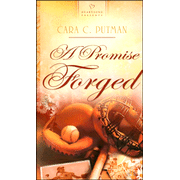
In my novel Stars in the Night, the heroine Audra has a charm bracelet that she plays with when nervous. In A Promise Forged, the heroine Kat is a ballplayer with the inaugural All American Girls Professional Baseball League in 1942, so she borrow a quirk from my grandpa and is constantly running a baseball through her fingers.  
 
In real life, I have a friend who always has a long-sleeved sweater on, no matter that it's 90+ degrees outside. I have another friend who keeps a running to-do list on a clipboard with sheets of notes -- in what appears to be random order. But she's one of the most organized people I know -- even if I could never make her system work.

Think about the people you know...most of them will have some unique quirk. Does she pluck their eyebrows out compulsively? Does she always wear big necklaces in layers? Does he always have a Swiss Army knife that he has to mail back every time he hits an airport?

These are the details that make people unique. They also serve as tells. "She must be nervous because she's doing X..." Your characters need these, too.

So what's the best quirk you've read in a character or given a character? And what's the best quirk you've seen in real life? I can't wait to see your answers!

Thursday, June 30, 2011

Moral Premise?

Right now I'm reading a book called the Moral Premise. The author Stanley D. Williams will teach the Early Bird at ACFW in September, and like any good hyper student, I wanted to get a head start on preparing. The Moral Premise reveals the foundational concept at the heart of all storytelling and successful box office movies. In concrete terms it explains how you can create your own success and, in the process, entertain, delight, challenge, and uplift this generation and the ones to come.

Hmmm, that's a lot to offer in one little book!

But as I think more about it, I think the author is on to something. Don't we all want to read books that challenge us to live better lives? That illustrate good v. evil? That show hope and redemption at the end?

One reason I write Christian fiction is my firm belief that if God is with us, which He promises He is, then no matter how bad things seem, there is always hope. And as the movie says, Hope Floats to the surface. Sometimes it just takes longer than other times.

In a nutshell, the premise of the Moral Premise seems to be that a movie or book that will resonate with its audience is one that illustrates the dichotimies of life. Illustrates the differences between choosing well and choosing evil.

The one John Grisham novel I wanted to throw against the wall had Goliath winning rather than David. I don't know about you, but in the books I read and write, I want hope to prevail...after the long, dark night.

Thursday, June 9, 2011

When the Storms Blow...

This week my church loaded a truck with diapers, food, baby food, toiletries, and kids clothing and sent it to Joplin, Missouri. The picture doesn't begin to convey how many boxes are layered in there. I really didn't think it would all fit...but it did!

A pastor from the church we are working with spoke at our church. He and his wife shared stories that would break your heart -- yet gave such hope at the same time. God is on the move.

In storms like this, I think we see who we really are. How strong we really are. What our core values are. What we are fundamentally made of at the core of our existence.

Some people experience a massive tornado -- possibly the most destructive in United States history. But for most of us, the storms are other things. In the last few days a friend had a husband tell her he never loved her and their life together has been a lie. F-5 on the scale of storms. Another friend learned that her cancer returned, this time in her bones. Another F-5 shock. Yet another friend went in for an ultrasound and learned her baby had no heartbeat. An F-5. Another friend learned that she was being asked not to continue on a public project. A F-5.

I'm sure you've had something similar happen. And as writers we have to place our chracters in the middle of life's storms, too. We have to run them through the wringer and see what emerges on the other side. Who they become.

So what do we do personally? And what do our characters do?

Do we lean into Jesus and His promises? Or do we rail against Him and shake our fists at heaven? Do we sink into His loving embrace like my six-month-old curls into mine? Or do we go rigid and turn away?

Praying that whatever the storm in your life, that Jesus would be bigger, present, and still it.

Thursday, April 28, 2011

Getting Our Facts Right...


Recently, I received some really amazing feedback for one of my historicals A Promise Forged. How does this tie in to a suspense blog? Hang with me a minute and you'll see.

First, you need to know a little about the story, set in 1943:

When Kat Miller makes All-American Girls Professional Softball League, she struggles with long road trips, grueling practices, and the challenge of making time for God. Not only that, but older teammates are jealous of her success and an irritating reporter, Jack Raymond, has a knack for getting under Kat’s skin.

I received a package from my editor a few weeks ago. When I opened up this package, I was instantly intrigued by its contents, especially the black and white baseball card autographed to me and the autobiography with a photo of a female softball player on the cover. The card is about to get put in a shadowbox frame -- it's an amazing gift.

It also came with a letter: "...A friend gave me the book because she knew I had played in the All-American Girls' Professional Baseball League in 1954 for the Grand Rapids Chicks. As I read the book, it was like I was walking in Kat's shoes, reliving my life again.I am enclosing a book I wrote about my ball playing days, and a signed baseball card....Thank you for the great story!"

This type of feedback is a dream come true for a writer. It lets us know all our research paid off and we got the details right. How often have you read a book that's moving along and then the author gets one fact wrong. While you were going with the characters before, now you can't. The error (no matter how small) is a glaring problem. It makes you doubt everything else. 

So for a historical, I spend time in archives and talking to historians and people who lived it. For a suspense I talk to arson investigators, police detectives, etc. But as a writer, we have to get the details right. 

And when we do? Serendipity!

Thursday, March 24, 2011

These are a few of my favorite things: Writing Books

This week, I'm on a bit of a research trip for a novella I'm writing. So I thought I'd share my favorite writing books.


Plot v. Character is a new writing book, releasing in the fall of 2010. Jeff Gerke, the author, has developed software (which I love) that walks writers through the creation of stories through two means. Starting with 1) the plot or 2) the character. Most writers have a style that they prefer -- I tend to be strange (shocking I know!) and will start some stories with a plot idea and others with a character. I'd used the software when I'd get stuck in a book or to help flesh out a germ of an idea.

What I love about the book is that it takes the gems from the software and puts it in a very easy to read and apply format. The book has lots of practical applications and covers just about everything a novel writer needs. It's not genre specific, so really is a tool that any novelists can use with success.

First, the book deals with creating likable characters. It addresses everything from physical attributes to the major events and inciting incidents that character must deal with. Then it turns to marvelous plots. The author relies on the three act structure to form the bones of the plot.  I would still use the software to help me implement all he talks about, but the book alone is gold.


Another book that I love and recommend to most aspiring writers is James Scott Bell's Plot & Structure. (His Revision and Self-Editing is equally good.) Plot & Structure's strength is the very easy way that Jim explains how to formulate a novel. When I get stuck in a plot, I'll pull it out and read a few pages for inspiration. I always come away with practical tools I can immediately apply to the novel I'm writing. And this book is loaded with excellent exercises that you can apply immediately after reading. I highly recommend it!

If you're a writer, what are your favorites? 

Thursday, February 10, 2011

Pushing Through

Have you ever noticed how life can get tough with the slightest disruption to routine. I have a nine week old. Disruption #1.

I have some funky cold/sore throat/ear thing. It wakes me in the middle of the night and keeps me up. Disruption #2.

My husband is traveling for work, leaving me a single parent. (My hats off to those of you who take that role every day!) Disruption #3.

Yet, my responsibilities don't lessen. I still get to put on all of my hats and juggle all my jobs. It's just the way it is.

I've been working on a proposal that still feels flat to me. And I think it's that there isn't enough conflict. The heroine doesn't have enough disruptions going on in her life at the same time. Now my job as the creator of the story world is to wreck some serious havoc in her life. And the Hero's. It seems mean, but if I don't compound everything going on in her life, then you as readers won't stay engaged.

So I'm off to create some disruptions. Some major disruptions. In her life.

Saturday, February 20, 2010

Time for the Gold Medal winners!

It’s time to award those Olympic gold medals to folks who slog through what can be one of the most discouraging sports of all….WRITING! So here’s Dana Mentink’s take on the gold medal winners in the Mystery, Romance and Christian Fiction genres.
And the Gold Medal in Romance goes to…Barbara Cartland. Before her death she authored over 700 books! Seven hundred? I’m happy to be publishing number eight! After starting out as a gossip columnist, she went full tilt into the romance arena and in addition to her published words she left over 160 unpublished manuscripts. Can you imagine? Now THAT’S medal worthy!
And Gold Medal in Mystery goes to…Dick Francis. This was a tricky one but the best-selling British writer wrote 42 novels, incorporating his own life experiences as a jockey. A favorite with the Queen’s mother, he was made a Commander of the British Empire. He wrote all his stories out longhand and his faithful wife read, edited and transferred them to the computer. His son Felix once said his parents were like “Siamese twins conjoined at the pencil.”
And finally in the area of Christian Fiction, the gold medal goes to… Jerry Jenkins. Though I struggled with this category as there are so many inspirational authors I love (a nod to Jan Karon here) Jenkins really put Christian Fiction on the map when his Left Behind series sold more than 70,000,000 copies. His recent novel Riven, will be shot as a movie this year.
So those are the gold medal awards presented by this judge. Your turn! Who would YOU award gold medals to in the writing world?

Friday, January 15, 2010

Writing Pros agree....or not.


Writing is not so hard now is it? One goes tappity tappity on the keys and after a while, it all adds up to a brilliant novel. Uh huh, and I’m in contention for a gold medal in Olympic ice skating. Fortunately, in the Writer’s Digest anniversary issue, there is a collection of some sage advice from the biggest names in writing, but alas, they don’t seem to agree on all the finer points. Let’s take a look.
Outlining anyone?
“I make a very tight outline of everything I write before I write it…” This comes from writer Tom Wolfe. So the outline is critical…unless you’re Robert Ludlum.
“Sometimes one can overanalyze, and I try not to do that. To a great degree, much of the structure has got to come naturally out of the writing,” Ludlum says. Hmmm.
Let’s take a look at inspiration.
From author Frank McCourt, “Sit and quiet yourself. Luxuriate in a certain memory and the details will come. Let the images flow.”
Andy Rooney is more pragmatic. “My advice is not to wait to be struck by an idea. If you’re a writer, you sit down and d*** well decide to have an idea. That’s the way to get an idea.”
Okey dokey. Let’s try another topic. No matter what the project, great writers no doubt share that sense of confidence, of knowing they are masters of the written word. Don’t they?
“Every idea is my last. I feel sure of it. So, I try to do the best with each as it comes and that’s where my responsibility ends. But I just don’t wait for ideas. I look for them. Constantly. And if I don’t use the ideas that I find, they’re going to quit showing up.” – Peg Bracken
And from the supremely confident John Toland, “I’ve always had complete confidence in myself. When I was nothing, I had complete confidence. There were 10 guys in my writing class at Williams College who could write better than I. They didn’t have what I have which is guts. I was dedicated to writing and nothing could stop me.”
So the bottom line? People are different. Writers are different. Life stories, motivations, world views are as different as fingerprints. We need to find our own way. I will close with a quote that applies well to all of us, no matter what the circumstance.
“Don’t quit. It’s very easy to quit during the first 10 years. Nobody cares whether you write or not, and it’s very hard to write when nobody cares one way or the other. You can’t get fired if you don’t writer, and most of the time you don’t get rewarded if you do. But don’t quit.” – Andre Dubus
So what works for you? What keeps you sitting in that chair writing away? Add your two cents about what keeps you writing.